

My sister called me the birthday Grinch when we were celebrating my 37th a few weekends ago. It’s the perfect description for the general grumpiness I experience on my birthday. Am I the only one?
I had an inflection point around age thirty-three, where birthdays started making me feel existential. I resemble equal parts Eeyore, moping around with his woe-is-me attitude, and Hamlet, philosophising on THE question, “to be or not to be”. There’s a sense that life doesn’t quite look the way I thought it would, which can lead to the wrong sort of party on one’s birthday - a self-indulgent pity party.
But if I take the time to reflect, I always see a rich vein of lessons from these trips around the sun. So, in what is becoming an annual tradition, I took the day off to write about some of the things I’ve learned or grappled with in the last year. These are mostly self-directed imperatives, lessons to myself from a year ago, or perhaps realisations that are slowly dawning on me.
Disclaimers:
Since I let them stew for nearly a month before making the time to edit and publish, I’m including a few lessons from the beginning of trip 38 as well, which has already yielded some pearlers.
Yes, dear reader. Some of these might apply to you, but the chances are slim. Please message me if you’re offended by anything; I’m open to having an in-person conversation. (@Cath, don’t worry — none of them apply to you. Skip to the end.)
Finally, I’ve gone over this a few times now and admittedly I feel a bit stuck. But I’m tired after spending most of a Sunday at my PC, and it’s nearly a month on, so I’m pushing publish anyways. Excuse any half-formed thoughts or inconclusive tangents. “A song is never finished only abandoned”. It’s all part of my long-term self-acceptance project.
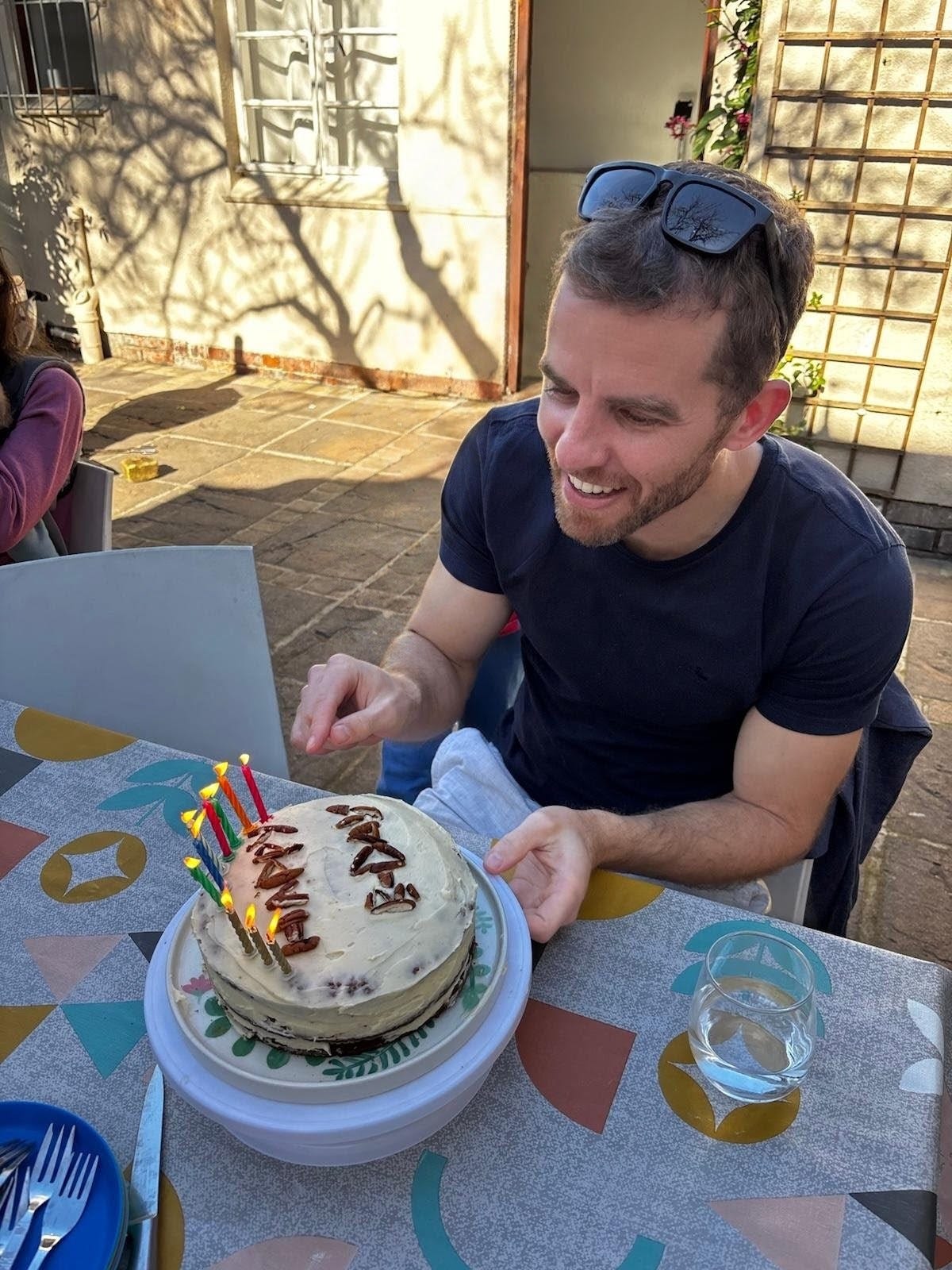
So here we go... reflections from trip 37 around the sun.
Starting off with a hodge-podge of thoughts to grease the pipes, and then maybe some structure will emerge.
Your feelings are valid, but don’t always trust your feelings. Some days, the feelings just hit. It’s impossible to predict when that will happen. But don’t let those feelings unsteady the ship. Maybe those feelings are coming from the seven-year-old part of yourself that you haven’t listened to in 30 years. Now’s the opportunity to listen to that part without letting it drive the bus.
Maybe I’m a SNAG? (Sensitive New Age Guy) As much as I loathe the idea of ‘New Age’, by most definitions I probably fall in that bucket. (If anything, I’m more hippy than normy on the spectrum.) I practise meditation, do yoga every now and then and do contact improv and ‘conscious dance’ classes. I also love a good spiritual side-quest. And, yes, I’m definitely sensitive. So with all that evidence, I’m probably a SNAG. Shit. There are some virtues in this, for example high empathy and high self-awareness. But there are also definite traps: the potential to be self-absorbed, and the risk of emotional contamination that might render one ineffective in a world that’s shouting doom and gloom. Learn to compartmentalise, and hold the paradox of suffering in the world, with the joy of life.
Women don’t want a lost puppy. They want a big dog. Safe, confident, secure; will bite when necessary. In crude modern terms, we can reduce this to “has status”, but that’s a gross over-simplification, and I’m sure many will contest this. Either way, I can own the fact that I’ve been in “lost puppy” mode for close on three years now. This roughly correlates to when I left my job and started producing online courses. Modern men get so much validation through our professions, and “info product sales” and “content creator” were archetypes that I felt a lot of resistance to. That left me with an identity crisis. Working a full-time job again has done wonders for my “I want to be a big dog” endeavours.
As you judge, so shall you be judged. Obviously, the judgment I had for YouTubers / content creators always selling their wares was recursive. But maybe therein lies another lesson: everyone is selling. Realistically, if I create something that’s valuable to people, and they purchase it and give good feedback, that’s a win. So why not do more? I believe the mental resistance is related to a failure to adhere to the next point.
Be impeccable with your word (borrowed from The Four Agreements), especially when speaking about yourself, i.e. don’t talk yourself down. I’ve called the online courses that I made “intellectual masturbation”, or productivity porn - productivity for the sake of productivity. I know people got a lot of value from them. But it felt so weird, being another guy on the internet with an opinion, a “content creator” telling you to “buy the course”. I know this is a valid way of making money, but it didn’t sit well with me. That’s a pretty solid reason why I couldn’t motivate myself more there. The psyche likes consistency.
I need to forgive myself for many things: for not having put more effort in, and for not investing in the marketing side of the business. In some ways I broke trust with a part of myself. The part that says, “you have the potential to make something out of this, so do the thing”. But it felt like there was some weird self-sabotage - a child-like part that said, “But I don’t want to”.
Some people like the jungle, some people like the zoo. When it comes to career and making money, some people like the wildness of entrepreneurial life, whereas others like structure and a paycheck. It’s not necessarily a binary, and it can change over time. I’m in a zoo phase at the moment; fences and food = certainty and stability. I still think I’ll probably venture into the jungle again, but only if I have a partner to do it with. Which leads me to the next point.
Working alone sucks. I always thought I wanted to work alone. This would allow me to do whatever I want, when I want, and not need to give an account for my time. But I didn’t foresee the trade-offs. All my time suddenly became a variable in an opportunity cost calculation, a lever I could pull to optimise. With no one to bounce things off of, it became an endless optimisation spiral.
This is a nice segue into the broader topic of relationships, a major area of thought for me over the year (very little of it romantic).
Relationships
One of my biggest fears in friendships is unreciprocated intent (by my definition, the unrequited love of friendships); that the people that I want to spend time with don’t want to spend time with me. There’s a fear that they’re only tolerating me, which of course betrays a lack of trust in their own sovereignty to express and act upon their desires. I have a suspicion it is the side-effect of growing up as the outsider of my twin sisters’ close relationship. And whilst there’s definitely something there, there’s another lesson baked in. If you identify as the victim, you’ll always be the victim.
This theme forms part of a thread I’ve consistently pulled on over the last few years: I’m still finding my places of belonging. Where do I call home? Where are the regular friendships I can ease into without fear of rejection or reprisal? How do I nurture new friendships and sustain old ones?
Unfortunately, I find myself in a bind. There’s an underpinning pattern where all of my relating is governed by time scarcity. There are simply more demands on my time than I can ever meet. This is probably relevant to many, but I’ll make it personal with a compounding factor. I have a certain rigidity when it comes to managing my time, which stems from how I view my job commitments. I’m paid a salary for a set amount of hours, and I’m pretty diligent at keeping up my end of the bargain. Some people say “You can’t focus for 8 hours a day”. I say, “Watch me.” This is an essay on its own, but the net effect is that time becomes a commodity, and interactions get drawn through the lens of transactions optimising limited resources.
It’s easy to make new friends; it’s difficult to make old friends. Getting to know people on a deep level later in life takes effort. A lot of it. Our old friends almost invariably come from school and university days, when there was plenty of time, both structured and unstructured, to spend time with peers, getting to know them in the daily rhythms of life. But when we leave that incubator and move into a world of 9-5s, adulting admin and busyness, the conditions that fostered friendships evaporate. Yes, there are some third spaces outside of work and home to connect with people. Maybe it’s the running club, the climbing gym or the church that you’re part of. But you need to show up consistently. You also need to be intentional with sending out the invites and aligning calendars. Frankly, it seems that deeper connections are more the result of luck than anything. And if you don’t have a community of practice, you’re really down-river without a paddle.
I don’t want my calendar filled wall to wall with commitments. Ah, the natural tension emerges. I want spaciousness in my life, a desire for spontaneity and flow. I also want to be able to recede into my cocoon from time to time. Yet making new friends and deepening relationships takes effort. Maybe I’m just in the wrong WhatsApp groups. Or maybe the WhatsApp groups are the problem? That we have extended “communities” of people that attend all the same gatherings, but with whom we don’t actually share a deeper part of our lives because we’re always in passing?
Sharing meals with friends is now my number one priority for social engagements. Not big group things where you flutter around like a social butterfly and never actually go deeper than “Hi, how are you?” Actually sitting around a table, hearing about people’s hopes and dreams, their hurts and fears. I would love to have a group of friends that I did this with on the regular. It’s a work in progress.
I don’t like phone calls. I’m saying it again: It’s not you, it’s me. The idea of scheduling a catch-up call makes me shudder. Dunbar had a point. There’s something to be said about relationships constrained by proximity. But the accessibility and literal zero cost of modern communication means that you can “keep in touch” with and “catch up” with people from past timelines very easily.
I feel tremendous resistance when old friends who live abroad want to schedule a call. Maybe it’s just the wording of “catching-up” that gets under my skin. As much as I love these friends, I inevitably end up feeling like I’m reporting on my life. I’d rather be creating new memories and discussing ideas in a lounge, than catching up on people, events and timelines on the phone.
Also, our lives have diverged so much, and I feel like layers of life have unfolded. The soil of beliefs and behaviours that allowed our friendships to grow is no longer shared, and I don’t think there’s room to share my experiences. No good reporting if you’re censoring the information, is it? I believe it’s possible to love someone deeply without the relationship staying current: to say a prayer for their goodwill, to celebrate the good news of their families and livelihoods.
Am I throwing the baby out with the bathwater? Maybe. I have this nagging fear that I’m putting distance between myself and others, only to find myself a lonely and bitter old man.
(That hits me every time I read it. Moving on.)
You don’t have to like everyone. Not everyone has to like you. It is nice to be liked. But to say yes to everyone is to say no to yourself.
If you’re not engaging in good faith, rather don’t engage at all. You need to believe the best of the person that you’re interacting with, otherwise what’s the point? You’re going to think they’re out to get you, or you will fall into a typical drama triangle where you’re the victim and others are the perpetrator or rescuer. Believe the best in people. If someone is unable to engage in good faith, step away. If someone is unable to take accountability for their mistakes, or see where they potentially were wrong, step away.
You have to be able to find common ground. If you can’t find the overlapping part of the Venn diagram where you’re both able to see the other’s perspective, you’re wasting your time. This is especially important in conflict resolution. You don’t have to agree on the view, but you have to be able to see it.
Commit, for goodness’ sake. If you say you’re going to do something, do it. I’ve experienced Cape Town / spiritually adjacent people as some of the most non-committal out there. All the plans up in the air, keeping their options open, “feeling into it.” Look, I get it. I’ve done this too. (Special mention to Leanne, who was on the receiving end of my indecision in a most unfortunate way.) And I did this a few days ago too. I had a plan, but something else came up. (I called the person and ended up moving our initial time; thanks for your graciousness, Leah.) With those caveats aside, let me get back on my high horse... Frankly, I don’t feel like being an option on your menu, part of some expected value calculation. Nobody’s articulating it, but it’s clearly going on. It doesn’t matter who else is coming; it matters that I invited you and that I want to spend time with you. If you don’t want to be there for me and are worried about who else is going to be there, rather don’t come. (If you’re asking out of curiosity’s sake, fine. But check your reasoning.)
Consistency is important to me. I already have a sense for the people who are going to show up late or bail on plans at the last minute. You have a sense for it too. You know the person in your group of friends that is “unreliable”? Don’t be that person.
Being on time is important to me. Why is it so difficult for people to be on time? If you have a professional meeting or a dentist’s appointment, you aren’t late for that. Why then are you late for a social engagement? A little bit of foresight goes a long way. If you’re going to be late, manage expectations.
Be careful when the language jumps into reductionism... For example: This is all just your projections. Yes, a lot of our interactions can be characterised by projections. But to automatically lump everything in that bucket is short-sighted.
...or where you’re required to communicate within a framework. Look, frameworks are cool. Non-violent communication is cool. But if I fuck up my words, and say “you made me angry” rather than “you did this thing, I’m feeling angry, this is my need”, let’s let that one go every now and again? See above for engaging in good faith.
Okay, enough seriousness. Let’s close this one on a light note.
Kiss your friends. But I’ll add a warning that this might be a bad idea. So far, the few friends I’ve kissed have resulted in more positive than negative experiences. But the negative experiences have caused enough harm to me and the kissee to say pasop. The only way to live this life is to risk contact with reality, but life rewards bold decisions.
Some self-help navel gazing and some sighs
(in an endless ocean of samsara, just for the rhyme)
Actually, no. Stop it. For fuck’s sake, less navel gazing. Do something for someone else. Donate to a charity, volunteer at a soup kitchen, give up your time for someone other than yourself. It’s not all about me and my feelings, my reality, my experience. Sigh. Me, my, mine, the gods of our time.
Dario, stop being mean to Dario. Easier said than done. Two steps forward, one step back. Sigh. Getting there.
Don’t expect other people to do what you won’t do. I love to say wealthy people should give more of their money away. What is the threshold, though? Surely I have some to spare that I can give away? But I’m saving for a house... But it’s the government’s responsibility to provide a social safety net for the poor... And yes, they’re fucking it up on a grand scale with our tax money, I know. Whilst there are valid reasons for not wanting to give away part of my earnings, the failings of government should not stop people from having their basic needs met. My contributions are insignificant, but maybe I’m making a difference for one starfish. Sigh. The complexity and scale of the problems we face as a society feels unresolvable.
I am not special. For some reason, I have always felt the need to prove I have an above-average IQ (golden boy syndrome). But lately, I feel dumber than ever. The complexities of this world seem to evade my understanding, and so I’m trying to narrow my sphere of concern, and slowly let go of the need to differentiate myself, or to have achieved something. (Yeah right, laughs the person who I voice-noted last night talking about how I keep comparing myself with peers). Sigh. The irony is not lost on me.
You are not a project, and I am not a project. I am a person. Your new modality is not going to help me. It probably won’t help you. Stop treating everyone and everything like a problem to be solved. Sigh. If I could just fix (fill in the blank).
Our brains are being collectively rotted by the slop and drivel that is algorithmically placed in our feeds. There is so much shit content out there. We’re at the feedlot of the factory farm of attention, being force fed a diet of engaging content, all in the hopes to sell more things. LinkedIn is pure AI drivel. Instagram is just ads. Sigh. But sometimes it’s good to distract myself.
Okay, enough sighs. Heck, don’t even know if that worked stylistically.
The brain can have both software and hardware challenges. I’ve been dealing with the software challenges for a long time (therapy, etc.). Turns out that addressing some of the hardware things can also yield a lot of benefit. (Thanks, Ashraf and Matthew of Neurovita. This is not a sponsored post)
Memory reconsolidation is a powerful mechanism for altering thought patterns. There are target behaviours. These are driven by deep seated emotional learnings. If you can identify the underlying learning, and identify contradicting evidence against this, you can depotentiate the ‘trigger’. You have to be taken to the edge of that underlying learning again, so that you can feel the effect in your body, before introducing the contradicting evidence. Lots of caveats. Look into it if you’re interested.
Grounding is a real thing. Instead of getting lost in the frenzy of the chaotic energy in your head, take a moment and feel yourself on the earth. Relax your butt cheeks, walk barefoot on the earth, hug a tree. Weirdly, playing old albums is very grounding. You know, the ones that existed before Spotify became a thing where you could mainline any song you ever dreamed of, leaving yourself wondering what it actually is that you want to listen to right now. Great grounding albums for me: Alt-J - An Awesome Wave, Ben Howard - Every Kingdom.
Humans love looking for simplified models to understand the world. Astrology, numerology, things with patterns. If we can predict it, we can manage the responses. Prediction models are the OxyContin of uncertainty. Look, I’m highly sceptical that celestial bodies have tangible impacts on human emotions. But it’s inherently unfalsifiable, so I might as well play the game a bit and embrace my Leo-ness.
Pay attention to your dreams. Whilst some dreams can be insignificant, where the brain is just clearing memories from the day, many are the unconscious’ way of communicating things that are important for you to take notice of through archetypal images. Often characters in our dreams represent the unintegrated parts of ourselves. (The angry, homeless one inside me is having a field day.)
Believing in magic feels like a better position to take than not believing in magic. But there’s an insipid cruelty in coupling it with the agency to make economic changes in the world. Ultimately it’s easy to believe in magic(k) when you’re on the financially well-off side of the Gini coefficient. So with this, a quick request: if your manifesting is working so well for you, please consider manifesting some abundance on the other side of the train tracks.
The “default world” is the world. Capitalism is the dominant economic system. You are not overthrowing it by living in your off-grid community. You are choosing not to participate in it, but it still affects 99.9% of the world around you. You can’t change the system by attacking it. Come up with something better that is actually scalable, i.e. works for the global population. If you want to talk about the “default” world, please try to do something that serves the “default” people. Oh, that’s everyone. You are not a special class of citizen, no matter how much psilocybin, LSD or DMT you’ve ingested.
Anger is the deepest form of care (borrowed from David Whyte). Anger is a healthy, energising emotion when channelled appropriately. But it’s also the most destructive. Keep practising healthy anger. Acknowledge unhealthy anger, and take accountability for it.
Acknowledge the longing... The desire for companionship, which is lit up with pangs of loneliness; the desire for “peace that surpasses all understanding”; the desire to embrace the fullness of my being; the desire for some of the creature comforts of life...
...but practise contentment. What if today was actually a good day? What made it so? Imagine what it would feel like if everything was just as it is supposed to be. Now feel that, and let it flow over you. Feel the warm embrace of self-acceptance as you imagine being comfortable in your own skin. Imagine it takes the same shape as the sun’s rays shining down on you as you drink your morning coffee on the bench. Let go of the fight; to be better, to do more, to fulfil some evolutionary imperative. That is old programming, meant to propagate your genes in an endless cycle. Give that evolutionary drive a little scratch on the neck and say “not today, you little shit.”
Finally, and most importantly, pursue virtue. What is virtue? It is the recognition of the inherent value of existence, without qualification. It is depth and beauty and resonance, and the Platonic ideal of ‘goodness’.
How do we pursue it? I think it requires a different gaze, beyond material appearances, and into the numinous connection of all things. I believe in a universal ideal that we are not separate, and are all manifestations of one consciousness. And that’s where Christ’s imperative to treat others as ourselves really hits home.
I daily fall short of that standard, though. It feels impossibly wrapped up in complex layers of socio-economic and spiritual oppression, taking shape most notably in poverty and addiction.
But it is way too big for you to carry it on your own. And you don’t have to carry it alone. Have high standards, but know that you are, in most senses, only human. Sometimes, direction matters more than velocity.
It’s okay, boy, you’re on the path.
This post is dedicated to new friends: Leah, Mikey, Ashraf, and Claire. Our conversations have been continually in my ears whilst writing this.
It is also dedicated to an old friend. Cath, for (eventually) seeing past my poor delivery, and who brought me delicious cake that sent me into a sugar coma on my actual birthday. 19 years and counting.